
Seema Aziz
Program & Services Media & Stories Community Section About Us Program & Services Media & Stories Community Section About Us Support Now Seema Aziz From Entrepreneurship to Education: Building a…
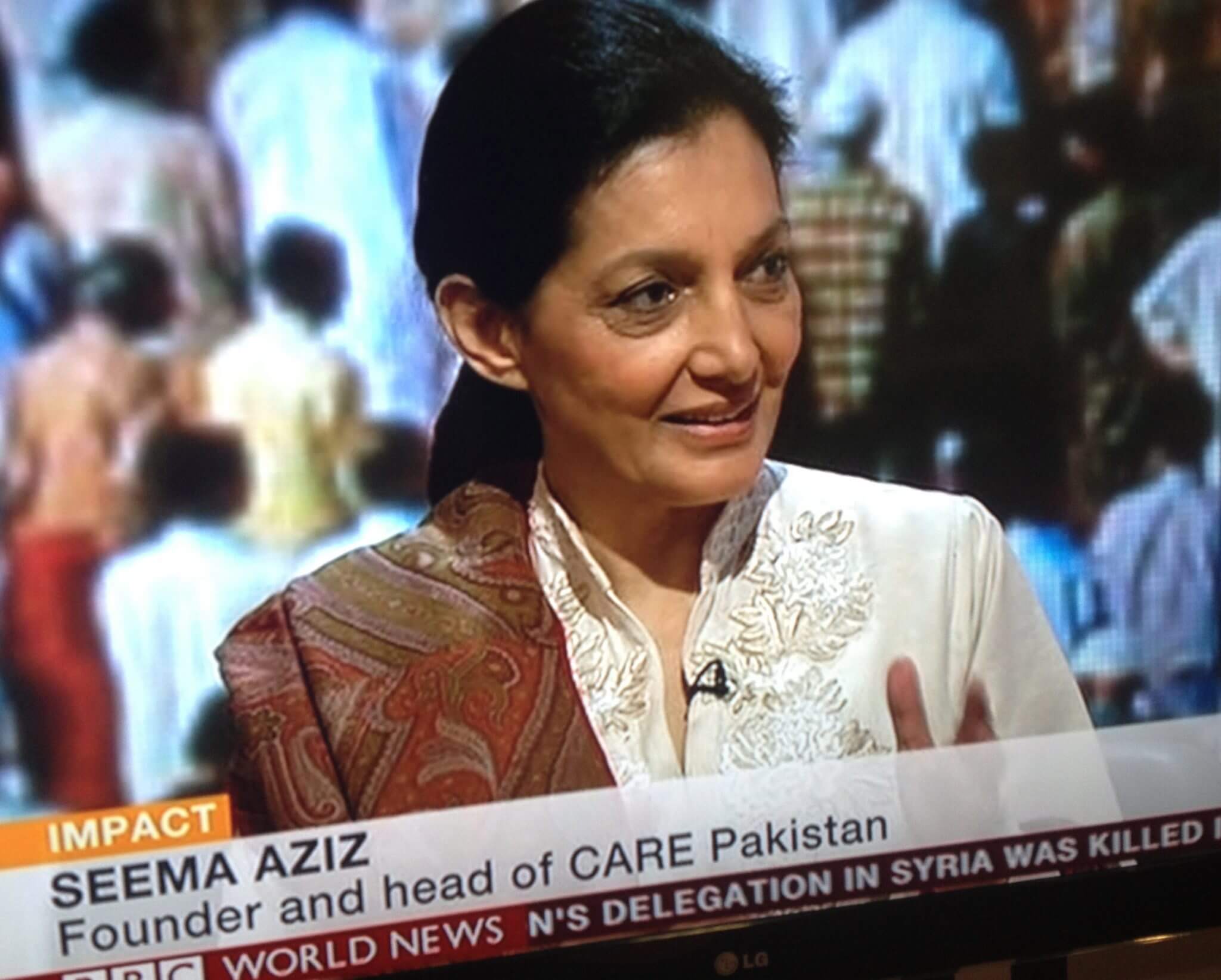
Seema Aziz is a prominent Pakistani entrepreneur, educationist, philanthropist, and social activist whose career demonstrates how business success can be transformed into lasting social impact.
Her story is unusual because she built influence in two very different worlds. In the business sector, she co-founded Sefam, the company behind the well-known Pakistani fashion brand Bareeze. In the social sector, she founded CARE Foundation and developed it from a small initiative into a major education organization serving hundreds of thousands of children.
Her journey demonstrates that entrepreneurship and social responsibility do not have to exist separately. Business can create economic value, while social entrepreneurship can create human value. Seema Aziz’s career brings these two dimensions together.
Seema Aziz entered business at a time when Pakistan’s textile and fashion industry had considerable potential but lacked internationally competitive Pakistani brands producing high-quality embroidered fabrics. In 1985, she and her brother co-founded Sefam with an ambition to create high-quality fabric in Pakistan. Harvard Business School’s account of her career describes how the company focused on controlling different stages of production to maintain consistent quality. The challenge was not simply producing fabric. The bigger challenge was convincing customers that a Pakistani company could produce products meeting international standards. Seema Aziz approached this challenge through quality, consistency, attention to detail, and long-term brand building. This became one of the defining principles of her entrepreneurial career.
For Seema Aziz, education represented a different form of philanthropy. Food can solve an immediate problem. Financial assistance can provide temporary relief. But education can fundamentally change a person’s future. This philosophy became central to CARE’s mission. The organization focused on providing quality education to children who might otherwise have limited access to good schools. The underlying idea was simple: If poverty is partly sustained across generations through lack of opportunity, education can become a mechanism for breaking that cycle.
The adoption of government schools became one of the most important elements of CARE’s approach. Instead of building every school from scratch, the organization could take over schools that already had infrastructure but were struggling to provide quality education. This model had the potential to increase impact more quickly. It also demonstrated an important principle of social innovation: Sometimes the best solution is not to build a completely new system, but to improve an existing one. This approach allowed CARE to work at a much larger scale while focusing its resources on educational quality and management.
Seema Aziz’s career is also significant as an example of women in Pakistani entrepreneurship. She entered business in a period when women entrepreneurs faced considerable social and cultural barriers. Harvard Business School’s oral history notes the cultural challenges she encountered, including skepticism around her decision to enter business and the difficulty of introducing an unusual product to the market. Her success demonstrated that women could build and lead large commercial organizations. She subsequently carried that leadership experience into the education sector. Her journey therefore represents two forms of empowerment: economic empowerment through entrepreneurship, and social empowerment through education.
Under Sefam, Bareeze developed into one of Pakistan’s best-known fashion brands. The company demonstrated that Pakistani craftsmanship could be transformed into a sophisticated commercial product and positioned for both domestic and international markets. The success of Bareeze was significant because it helped challenge the perception that Pakistan could primarily compete through low-cost production. Instead, the company focused on quality, design, branding, and value creation. For Seema Aziz, entrepreneurship was therefore not simply about selling a product. It was about creating a Pakistani brand capable of competing in a wider market. Her experience in building Sefam would later influence how she approached the management of CARE Foundation.
The most remarkable aspect of CARE’s development is its scale. What began as a response to one community’s educational needs developed into a large education network. CARE says it now manages 888 schools and serves more than 285,000 students, while its model includes both building schools and adopting existing government schools. This transformation required more than philanthropy. It required organizational systems, financial management, human resources, teacher development, monitoring, curriculum management, and institutional leadership. In other words, Seema Aziz applied many of the principles she had learned in business to the social sector.
A common theme connects Seema Aziz’s business and social ventures: quality. In Sefam, quality was central to building a Pakistani fashion brand capable of competing internationally. In CARE, quality became central to the educational mission. This consistency is an important leadership lesson. Seema Aziz did not treat education for disadvantaged children as something that could be delivered at a lower standard. Instead, the philosophy was that children from low-income families should have access to quality education. Harvard Business School’s case material highlights this parallel between her two ventures: a commitment to quality and the belief in leading by example.
Growth creates new problems. A small organization can operate through personal relationships and direct supervision. A large organization requires systems. As CARE expanded, Seema Aziz faced the challenge of maintaining educational quality while increasing the number of schools and students. LUMS has documented a dedicated case study on CARE’s leadership under Seema Aziz. The case examines a major strategic dilemma: whether to accept responsibility for a large number of government schools and accelerate educational reach, or to grow more slowly while protecting organizational capacity. This is an important leadership dilemma. Impact versus capacity. The greater the opportunity to create impact, the greater the organizational demands.
The second major chapter of Seema Aziz’s story began after the devastating floods in Pakistan in 1988. While participating in relief efforts, she and a group of concerned citizens went to help affected communities. During this work, they encountered an area where children had no school. Instead of limiting the response to immediate relief, Seema Aziz identified education as a longer-term solution. CARE Foundation was founded in 1988, and its first school opened in 1990/1991. The organization’s own history states that the initial effort emerged from flood rehabilitation work and that CARE subsequently expanded its mission to provide quality education to disadvantaged children. This was the moment when her career moved from entrepreneurship into social transformation.
One of the most important lessons from Seema Aziz’s career is that social organizations also need professional management. A charitable initiative may begin with passion. But to serve hundreds of thousands of people, passion must be supported by systems. CARE’s growth illustrates this principle. The organization developed models for both building schools and adopting existing government schools. CARE’s history records that the City District Government Lahore approached the organization in 1998 to adopt and manage failing government schools. This created a significant leadership challenge. Taking responsibility for existing public schools meant dealing with larger systems, more employees, greater financial requirements, and institutional complexity.
Seema Aziz’s work reflects a broader understanding of education. Education is not simply about examination results. It affects employability, confidence, social mobility, civic participation, and economic opportunity. CARE’s current mission emphasizes providing children with the knowledge, confidence, and skills needed to take greater control of their futures. This makes education a long-term investment in human capital. For Pakistan, where millions of children remain outside the formal education system, such interventions can have implications far beyond individual students.
CARE’s work has also expanded beyond primary and secondary schooling. The foundation supports higher education opportunities for deserving students, including a scholarship programme supporting students pursuing college and university education. This reflects a broader understanding of educational empowerment. Getting a child into school is only the beginning. The ultimate objective is to create a pathway through which that child can develop the skills and qualifications needed to participate fully in society and the economy.
Seema Aziz’s leadership can be understood through several defining characteristics.

She was able to see possibilities beyond the immediate problem—whether building a Pakistani fashion brand or responding to a community’s lack of education.

Quality has remained a consistent principle across her commercial and social ventures.

She applied business principles such as systems, efficiency, scaling, and sustainability to social development.

Entering business and building a major educational organization required the willingness to challenge established assumptions.

Her work demonstrates a focus on creating institutions rather than temporary initiatives.
Perhaps the most important lesson from Seema Aziz’s career is the relationship between business and social impact.
Her journey can be represented as:
Entrepreneurship → Business Success → Experience & Resources → Social Investment → Institutional Development → Large-Scale Impact
This is a powerful model for modern philanthropy.
It suggests that successful entrepreneurs can use their knowledge, networks, management capabilities, and resources to address major social challenges.
Rather than treating philanthropy as separate from professional life, Seema Aziz demonstrated how the two can reinforce each other.
Seema Aziz’s impact can be divided into two major areas.
Through Sefam and Bareeze, she contributed to the development of Pakistan’s branded fashion and textile sector and demonstrated the potential for Pakistani products to compete internationally.
Through CARE Foundation, she has contributed to expanding access to education for hundreds of thousands of children. CARE’s current figures indicate a network of 888 schools and more than 285,000 students. Together, these represent a distinctive form of leadership: creating economic value while simultaneously building social value.
Seema Aziz’s story is ultimately a story of transformation.
She transformed the idea of Pakistani textile products into an internationally recognized business through Sefam and Bareeze.
She then transformed a response to a local educational need into CARE Foundation, a large education organization serving hundreds of thousands of students.
Her journey demonstrates that entrepreneurship does not have to end with business success.
It can become the beginning of a much larger responsibility.
Her greatest contribution may therefore lie in showing that the skills required to build a successful company—vision, quality, discipline, systems, leadership, and the ability to scale—can also be applied to solving some of society’s most difficult problems.Conclusion
Seema Aziz’s legacy is the bridge she built between entrepreneurship and social transformation—demonstrating that a successful businesswoman can use the same principles of quality, leadership and scale to create opportunities for those who have the least access to them.