
Breaking Barriers in Military Medicine and Institutional Leadership
Introduction
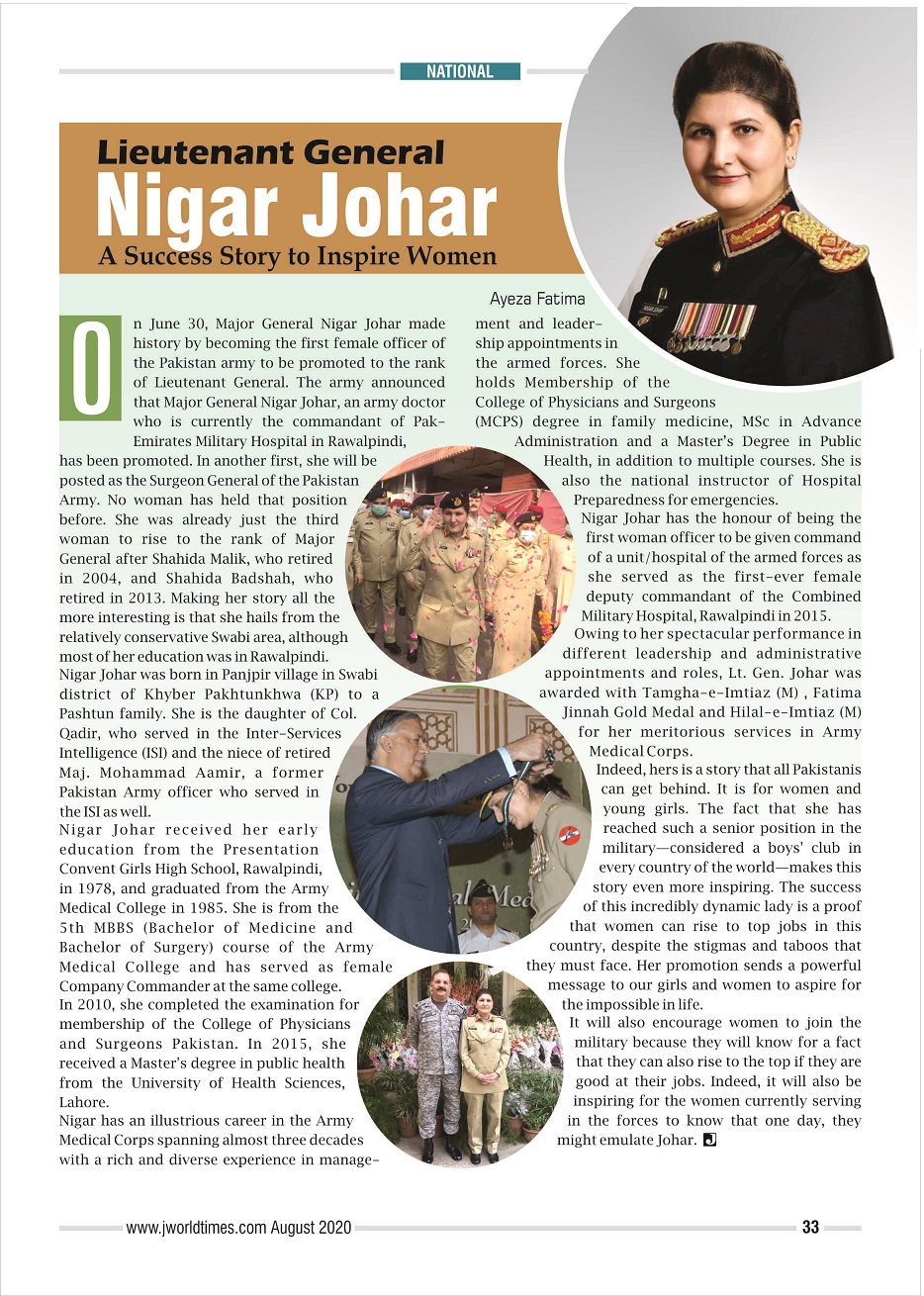
Lieutenant General Nigar Johar represents one of the most significant stories of women’s leadership in Pakistan’s institutional history. A physician and senior military officer, she became the first woman in Pakistan to attain the rank of Lieutenant General and subsequently served as the first female Surgeon General of the Pakistan Army.
Her journey is significant not simply because she reached a senior military rank, but because she achieved it within one of the country’s most disciplined, hierarchical, and traditionally male-dominated institutions.
Her career provides an important case study in professional excellence, discipline, resilience, institutional leadership, and breaking traditional barriers.
Rather than positioning gender as the defining element of her career, her professional journey demonstrates how competence, commitment, leadership ability, and sustained performance can create pathways into positions historically inaccessible to women.
A Journey of Courage and Achievement
1.Women and Institutional Leadership
Women in Pakistan have increasingly entered professional fields such as medicine, education, law, business, technology, and public administration. However, senior leadership within highly structured institutions has historically presented additional challenges. Military institutions operate through strict hierarchies, demanding professional standards, discipline, and leadership structures. Reaching senior command positions requires years of service, professional competence, operational experience, and the ability to lead large organizations. For women, progressing through such environments can carry additional social expectations and stereotypes. Nigar Johar’s career became significant because she demonstrated that women could rise through these structures on the basis of professional achievement and leadership.
4. Breaking the Rank Barrier
A defining moment in Nigar Johar’s career came when she became the first woman in Pakistan to achieve the rank of Lieutenant General. This was a historic milestone. The significance of the achievement extended beyond the individual appointment. It challenged traditional assumptions about the positions women could occupy within Pakistan’s military institutions. Her promotion created a powerful symbolic message: Leadership positions should ultimately be determined by capability and professional performance rather than assumptions about gender. For women entering professional careers, such representation can have a significant psychological and social impact. It expands the boundaries of what future generations believe is possible.
7. Women in STEM and Medicine
Nigar Johar’s story is particularly relevant to women pursuing careers in science, technology, engineering, mathematics, and medicine. Medicine itself requires years of education and professional development. Her career demonstrates that women can move from technical expertise into senior leadership. This is an important distinction. Women are often encouraged to become professionals, but leadership opportunities require an additional level of confidence, institutional experience, and willingness to accept responsibility. Nigar Johar’s journey demonstrates the importance of creating pathways where women can progress from professional roles into decision-making positions.
2. Beginning with Medicine
Nigar Johar entered the Pakistan Army as a medical professional. Her medical background provided the foundation for a career combining two demanding disciplines: medicine and military leadership. Military medicine requires physicians to operate within a highly organized institutional environment while dealing with responsibilities that can extend beyond conventional clinical practice. A military medical leader must understand healthcare delivery, administration, personnel management, institutional planning, and organizational discipline. This combination gave Nigar Johar an opportunity to develop leadership capabilities beyond medicine itself. Her progression illustrates how professional expertise can become the foundation for broader institutional leadership.
5. Becoming the First Female Surgeon General
Nigar Johar later became the first woman to serve as Surgeon General of the Pakistan Army. The position represented the culmination of her medical and military leadership career. As Surgeon General, her responsibilities were connected to the Army’s medical services and the broader military healthcare system. The role required institutional leadership rather than simply clinical expertise. Managing a large medical organization requires strategic thinking, coordination, administration, resource management, professional standards, and long-term planning. Her appointment therefore represented both a milestone for women and a recognition of her professional capabilities within military medicine.
8. The Importance of Representation
Representation has an important role in changing social expectations. When a woman becomes the first to reach a previously inaccessible position, the immediate achievement is personal, but the long-term effect can be broader. Young women who see women occupying senior positions may begin to imagine themselves in similar roles. The importance of Nigar Johar’s achievement therefore goes beyond the title itself. She became an example of what professional progression could look like for women within highly structured institutions. Her story can encourage young women to view leadership not as something reserved for a particular gender, but as something earned through capability, commitment, and performance.
3. Building a Career Through Professional Excellence
Senior military leadership is generally the result of a long professional journey rather than a single achievement. Nigar Johar progressed through different responsibilities within the Army Medical Corps and gained experience in military medical institutions. Her career required continuous professional development and the ability to perform within a demanding organizational structure. This long-term progression is an important part of understanding her success. The story is not simply about becoming the first woman to reach a particular rank. It is about the years of professional performance that preceded that milestone.
6. Leadership in a Highly Structured Institution
One of the most important lessons from Seema Aziz’s career is that social organizations also need professional management. A charitableNigar Johar’s career offers an interesting perspective on leadership within a hierarchical organization. Military institutions emphasize: Discipline Accountability Chain of command Professional competence Teamwork Responsibility Decision-making These principles are applicable beyond military organizations. For corporate and public-sector leaders, her career demonstrates the importance of combining technical expertise with organizational discipline. Being an expert in one’s field is not enough to lead a large institution. Leaders must also understand people, systems, processes, resources, and organizational objectives. initiative may begin with passion. But to serve hundreds of thousands of people, passion must be supported by systems. CARE’s growth illustrates this principle. The organization developed models for both building schools and adopting existing government schools. CARE’s history records that the City District Government Lahore approached the organization in 1998 to adopt and manage failing government schools. This created a significant leadership challenge. Taking responsibility for existing public schools meant dealing with larger systems, more employees, greater financial requirements, and institutional complexity.
9. Challenges of Breaking Traditional Barriers
Breaking a professional barrier rarely happens in isolation. Women pursuing leadership careers can face expectations about what roles are considered appropriate for them. In highly demanding professions, women may also have to overcome assumptions about their ability to handle responsibility, pressure, authority, and organizational leadership. Nigar Johar’s career demonstrates the importance of consistency. A single achievement may attract attention, but sustained professional performance creates credibility. Her progression through the military medical system shows how long-term competence can gradually change perceptions.
10. Leadership Beyond Gender
One of the strongest lessons from Nigar Johar’s career is that successful leadership should ultimately be evaluated through performance.
Her story is often described through the lens of being the “first woman” to achieve historic milestones.
That is understandably important.
However, her career can also be viewed through another lens: professional leadership within military medicine.
Her medical expertise, institutional experience, leadership responsibilities, and ability to operate within a demanding hierarchy are equally important elements of the story.
This creates a more meaningful understanding of women’s leadership.
The goal is not simply to celebrate women for occupying positions because they are women. The goal is to recognize women as capable leaders whose expertise and performance deserve the same institutional recognition as anyone else’s.
11. Leadership Characteristics
Nigar Johar’s career can be examined through several leadership characteristics.

Discipline
Military leadership requires a high level of personal and professional discipline. Consistency over a long career is essential.

Professional Excellence
Her rise through military medicine demonstrates the importance of developing deep expertise in one’s field.

Resilience
Long careers in demanding institutions require the ability to manage pressure, setbacks, and changing responsibilities.

Institutional Thinking
Senior leadership requires understanding systems rather than focusing only on individual tasks.

Representation
Her historic achievements created visibility for women within Pakistan’s military and medical leadership.
12. Broader Impact
Nigar Johar’s impact can be considered across several dimensions.
Social Impact
Her achievement challenged traditional perceptions about women’s professional capabilities.
Inspirational Impact
For young women pursuing medicine, public service, and other demanding professions, her journey provides an example of long-term professional advancement.
Institutional Impact
Her leadership represented an important development within Pakistan’s military medical establishment.
Professional Impact
She demonstrated that a woman physician could progress to one of the highest levels of military medical leadership.
13. Lessons for Future Women Leaders
Conclusion
Lieutenant General Nigar Johar’s career represents a landmark story of women’s leadership in Pakistan.
As a military physician, Lieutenant General, and former Surgeon General of the Pakistan Army, she achieved historic milestones within a highly structured institution.
Her journey demonstrates that leadership is built through professional excellence, discipline, resilience, experience, and the ability to accept responsibility.
Her achievement as Pakistan’s first female Lieutenant General and first female Surgeon General is significant not only because of the historical titles themselves, but because of what those milestones represent for future generations.
Her story challenges the idea that certain leadership positions belong exclusively to men.
At the same time, it offers a broader lesson: sustainable leadership is not created by breaking one barrier alone. It is created by developing the expertise, discipline, credibility, and resilience required to remain effective after the barrier has been broken.
Legacy Statement
Lieutenant General Nigar Johar’s legacy is not simply that she became the first woman to reach a historic military rank; it is that her journey expanded the definition of what women in Pakistan can aspire to achieve in medicine, leadership, and public institutions.

Stay connected with Her Planet for updates, events, and inspiring stories from women across the nation.
Media & Insights
Newsletter
Join the Her Planet community and stay inspired
- Contact Us: 0323 8478079